
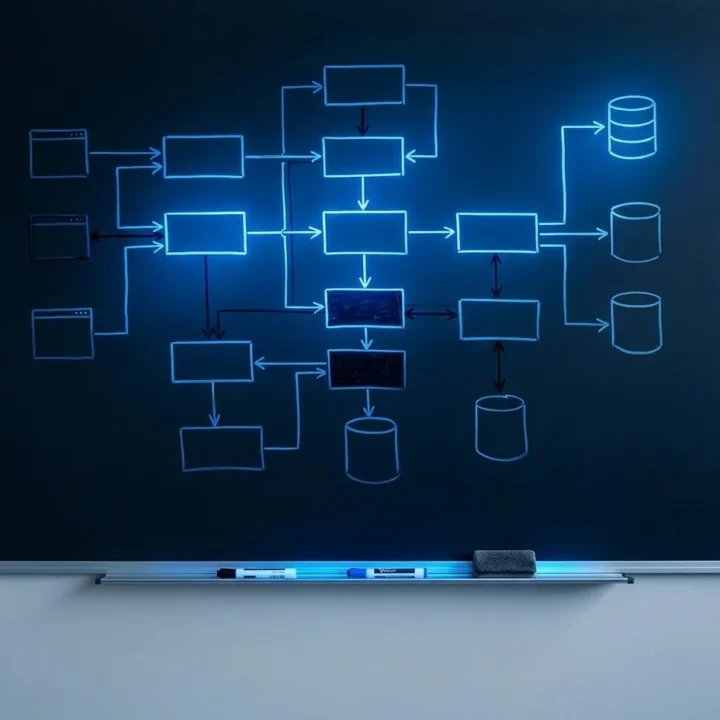
Technical specification before development defines data flows, system boundaries, and edge cases before a single line of code is written. Pre-development architectural planning prevents duplicate refactoring, performance bottlenecks, and misalignments across engineering teams. This guide breaks down the three foundational principles for building a resilient technical specification: data and state machine modeling, explicit interface contracts, and failure handling strategy.
When building a complex feature in an existing or greenfield system, the temptation to jump straight into coding is high. However, hands-on experience in building custom software platforms demonstrates that most engineering delays stem not from syntax errors, but from unaddressed logical gaps.
What Is the Purpose of an Engineering Architecture Specification?
An engineering architecture specification is neither a Product Requirement Document (PRD) nor a visual walkthrough of user interfaces. Its sole purpose is answering one question: how will the system execute the requirement in practice while maintaining performance, data security, and long-term maintainability?
In development teams lacking a structured pre-development technical specification process, developers are forced to make critical architectural decisions on the fly. This often results in data models that cannot accommodate edge cases, heavy queries that choke the database, and fragmented patch-upon-patch code. Investing a few focused days in upfront architecture saves weeks of regression debugging and refactoring down the road.
The Three Principles of Feature Architecture Planning
The architectural planning process for a complex feature consists of three sequential steps, each building upon the last.
1. Data Modeling and State Machines
The core of any software feature is the information it processes, persists, and displays. At this stage, engineers precisely define:
- Entity structures and relationships: Rigorous definition of database fields, data types, indexing strategies, and relational foreign keys.
- Entity lifecycle: Explicit mapping of every possible state (e.g., pending, in_progress, completed, failed, cancelled) and the precise preconditions for transition between them.
- Consistency and atomicity: Pinpointing which operations must run within an indivisible database transaction to prevent orphan records or corrupted partial states.
Clear modeling of edge-case states at the data layer prevents frontend engineers from implementing fragile client-side workarounds when presenting status changes.
2. Explicit Interface Contracts and Separation of Concerns
The second principle governs how independent modules communicate. Whether connecting the client application to a backend API or implementing third-party system integration, teams must produce an unambiguous endpoint specification:
- Request and response payloads: Mandatory attributes, optional parameters, strict timestamp formatting, and standardized error schemas.
- Authentication and authorization: Identity verification protocols and granular attribute-level permission checks for each endpoint.
- Parallel execution: Freezing the contract early allows frontend developers to build against mock data while backend engineers develop business logic simultaneously without blocking each other.
3. Graceful Degradation and Failure Planning
Software runs in unpredictable network environments where third-party APIs fail, latency spikes, and connections drop. Mature architecture assumes every dependency will eventually fail, as detailed in our guide on Core System Integration: Enterprise Architecture Guide.
The technical specification must document failure modes in advance:
- Retry policies: Implementing exponential backoff with jitter to avoid hammering a struggling service.
- Default fallback behavior: Specifying whether users receive cached data, a clean informational fallback, or a degraded feature subset.
- Fault isolation (circuit breakers): Programmatically cutting off requests to an unresponsive service to protect the rest of the application ecosystem from cascade failures.
Engineering Trade-offs During Pre-Development Planning
Every architectural choice involves weighing benefits against architectural cost. Three key trade-offs require deliberate decisions in every specification:
| Decision Axis | Option A | Option B | Guiding Decision Criterion |
|---|---|---|---|
| Latency vs. Complexity | Synchronous real-time execution | Asynchronous queue-based processing | If the job takes longer than a few seconds, background queues are essential to prevent UI blocking. |
| Extensibility vs. Simplicity | Broad generic abstraction for future use | Lean implementation for current scope | Premature abstraction increases ongoing maintenance overhead; build simply and refactor when scale demands it. |
| Execution Layer | Client-side evaluation (Frontend) | Centralized server execution (Backend) | Critical validation, transactional calculations, and access control must always execute on the server. |
Common Failure Modes When Foregoing Architecture Planning
Skipping the technical specification phase leads directly to recurring architectural pitfalls:
- Business logic leakage to frontend: Client developers receiving unformatted or unaggregated data are forced to run business calculations in the browser. Beyond degrading client performance, this creates vulnerabilities and compromises intended UX and UI design workflows.
- Race conditions: Concurrent requests writing to identical database rows without optimistic or pessimistic locking overwrite each other, causing silent data corruption.
- Database schema instability: Altering database tables mid-sprint without migration scripts risks catastrophic downtime during production deployments.
A rigorous architectural specification before development is not bureaucratic delay; it is the most reliable path to deploying robust, scalable software into production.
Common questions
How much time should be spent on a technical specification before development?
The duration depends directly on technical complexity and interface boundaries. For an average feature in an established application, specification typically takes two to five days of focused architectural design. For core database overhauls or multi-system enterprise integrations, allocating roughly ten percent of the total estimated sprint effort to technical specification ensures robust execution without wasted sprint velocity.
What is the primary difference between a product specification and a technical specification?
A product specification defines what the application does, target user outcomes, and visual user interactions. In contrast, a technical specification details how engineering implements those requirements across the stack. It focuses on entity schemas, data mutations, communication protocols, edge-case validation, authentication, infrastructure scaling, and failure isolation boundaries across components.
Who must participate in the feature architecture specification process?
The process is spearheaded by a lead engineer or software architect collaborating with the product manager to align technical feasibility with functional objectives. In addition, backend and frontend developers who will implement the logic must actively participate in design reviews to identify hidden system constraints, data bottlenecks, and edge cases before final sign-off.
Share this article
Want us to take a look?
Tell us what you are building and we will come back within one business day.