
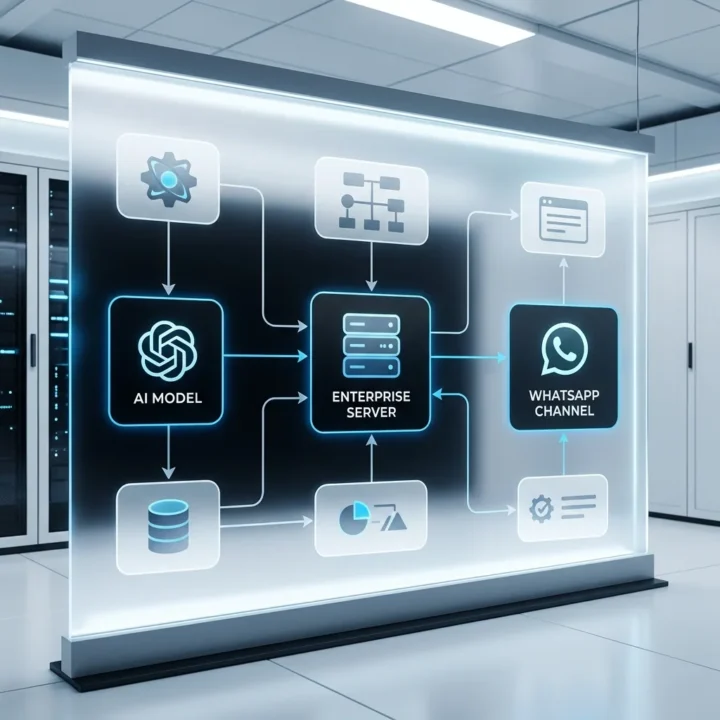
Connecting generative artificial intelligence to your primary customer communication channel fundamentally changes how conversations are handled, but it requires rigorous engineering of data pipelines. What you need to know before you integrate Meta AI into WhatsApp is that implementation success depends on maintaining a strict boundary between open-ended conversation and predefined operational tasks, validating input data, and deploying fallback architectures when dialogues derail. This guide examines how the model operates within the channel, structural differences between deterministic automation and generative AI, common failure modes, and critical architectural decisions before rolling out across enterprise systems.
The Purpose of AI in Messaging Channels
Integrating artificial intelligence into WhatsApp allows organizations to process natural language inquiries rather than restricting users to rigid menu trees. While traditional bots follow hardcoded decision paths, language models interpret user intent and generate responses tailored to the dialogue's specific context.
The primary objective of connecting these models is handling complex queries, providing technical explanations, and maintaining conversational flexibility. To understand how to architect model-driven conversational services, explore the principles behind AI and LLM development operating in production environments.
How the Mechanism Operates Behind the Scenes
The architecture powering an automated response system via a large language model relies on discrete components executing in sequence:
- Message Ingestion: The inbound user message arrives in the messaging channel and is routed via webhooks to the enterprise backend server.
- Context and History Retrieval: The backend retrieves conversation history and customer records from the database to supply the model with necessary background context.
- Instruction and Constraint Injection: The system wraps the user query with system prompts defining operational boundaries, tone of voice, and safety guardrails.
- Inference and Output Generation: The language model generates a text response, which is immediately evaluated by an internal validation layer.
- Response Transmission: The approved response is transmitted directly back to the user's active chat session.
Executing complex workflows that require autonomous handling and dynamic database queries requires a resilient backend infrastructure for AI agents to handle load spikes and isolate third-party failures.
Comparing Architectures: Rule-Based Automation vs. Generative Language Models
Selecting the right technical pattern depends on the nature of the transactions required during the interaction. The following table highlights the operational trade-offs between both approaches:
| Feature | Rule-Based Automation | Generative AI Models |
|---|---|---|
| Input Processing | Keyword matching and fixed menu navigation | Natural language understanding and intent extraction |
| Determinism and Accuracy | Fully predictable; identical input yields identical output | Probabilistic; phrasing and formulation vary |
| Maintenance Overhead | Continual manual updates to flowcharts and trees | Updating grounding documents, system prompts, and vector stores |
| User Flexibility | Rigid; typos or phrasing shifts can break execution | High; naturally resolves spelling errors, dialects, and slang |
| Hallucination Risk | Non-existent; responses are hardcoded by the organization | Present; requires active grounding and validation layers |
Connecting messaging channels to internal backends often relies on specialized gateway solutions. An architectural breakdown of these routing mechanisms is detailed in our guide on evaluating Watbox for WhatsApp Business API integration.
Common Vulnerabilities and Operational Failure Modes
Deploying a generative model directly in front of customers exposes customer-facing operations to several engineering failure modes that must be mitigated by design:
Non-Determinism and Fact Fabrication
Large language models operate probabilistically. Without strict data grounding, a model can generate incorrect statements regarding shipping timelines, return policies, or terms of service. To prevent this, models must never answer factual business queries from parametric memory alone; output must be strictly confined to verified data retrieved dynamically from internal databases.
Prompt Injection
Users can submit deliberate inputs designed to override system prompts, prompting the model to leak internal system instructions, reveal proprietary business logic, or output inappropriate statements on behalf of the company. Defending against prompt injection requires input sanitization, strict boundary framing, and pre-transmission output filtering.
Executing Actions Without Double Confirmation
Granting a language model permission to execute transactional operations—such as order cancellations, address changes, or account charges—based purely on free text comprehension creates critical operational risk. Any action that mutates state in core enterprise systems must require explicit user confirmation before execution rather than relying solely on probabilistic interpretation.
Designing Proper System Integration
For artificial intelligence to achieve business objectives without disrupting core workflows, teams must build an isolated middleware layer between the model and operational databases. The language model must never query internal data stores directly; instead, it outputs structured requests validated by backend services.
Activated Digital implements architectures built on this separation of concerns, ensuring every system connection enforces granular control over data flow. This engineering approach aligns with core patterns in enterprise system integration, where validation layers authenticate permissions and sanitize payloads before updating state.
A resilient deployment also requires an immediate escalation fallback to human agents whenever a conversation stalls, validation checks fail, or sentiment signals user frustration.
Common questions
Can a language model completely replace customer service agents on WhatsApp?
A language model cannot replace human representatives across every scenario. It excels at initial triage, intent classification, and resolving frequent inquiries using verified documentation. Complex edge cases, escalated complaints, or sensitive transactions requiring subjective business judgment must be routed seamlessly to human support staff.
How do you prevent artificial intelligence from hallucinating company information?
Hallucinations are mitigated using grounding architectures such as Retrieval-Augmented Generation (RAG). This architecture forces the model to synthesize answers solely from factual context retrieved from internal enterprise databases for that specific query, with explicit system instructions to state when information is unavailable.
What is the difference between a standard bot and a generative AI agent?
A standard bot follows deterministic decision trees and only responds to specific keywords or button clicks, failing whenever an input deviates. A generative AI agent interprets natural language, extracts entities and intent from unstructured text, and maintains contextual memory across multiple conversational turns.
Share this article
Want us to take a look?
Tell us what you are building and we will come back within one business day.