
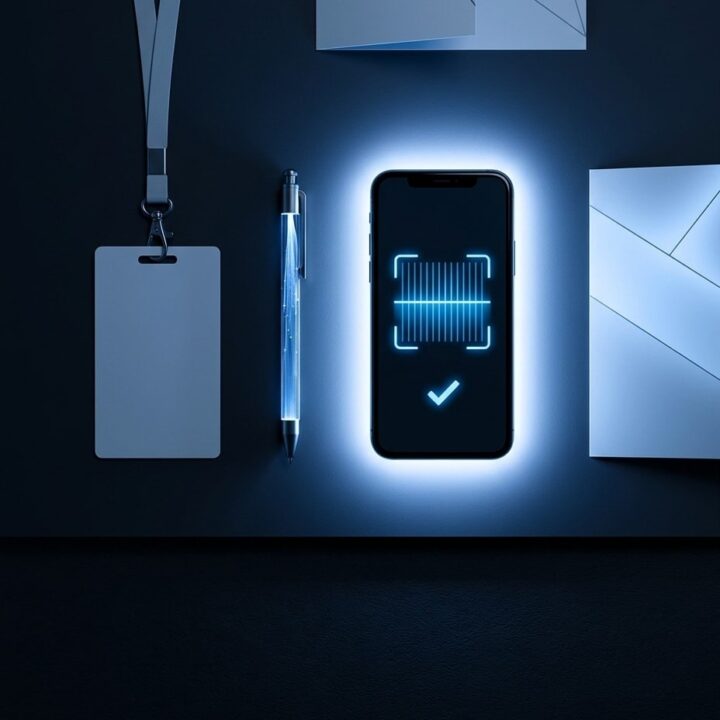
Smart event management without failures depends on a single engineering principle: decoupling gate admission throughput from the quality of the on-site internet connection. The irua.app platform, engineered by the team at Activated Digital, eliminates check-in bottlenecks using an offline-first architecture, sub-second QR code verification, and asynchronous event streaming. This breakdown details the architectural decisions, local cryptographic validation, and state synchronization pipelines that allow high-attendance conferences to operate continuously without entrance delays.
Offline-first digital check-in is an architectural paradigm where client devices validate attendee credentials against an encrypted on-device database without issuing real-time network requests, synchronizing transaction logs with central servers in the background whenever connectivity permits. Removing the network dependency from the critical path eliminates the recurring failure mode where hundreds of guests stall before a spinning loader at peak ingress.
The Check-In Bottleneck: Why Standard Client-Server Stacks Break
In conventional event admission stacks, credential verification requires a synchronous HTTP round trip: an optical sensor captures a payload, client software dispatches an API request across local Wi-Fi or cellular networks, a remote database processes the mutation, and the response unlocks the turnstile or notifies staff. When thousands of attendees assemble inside metal-and-concrete venues, local cellular base stations saturate and radio frequency interference degrades on-site Wi-Fi, driving latency up and triggering severe packet loss.
Under synchronous operations, an admission latency of two seconds per guest rapidly produces massive queues outside the venue doors. Worse, when connectivity drops entirely, check-in operations halt. Overcoming this single point of failure requires pivoting from network-dependent models to distributed systems. This approach forms the foundation of custom platforms and systems designed to guarantee operational resilience regardless of external infrastructure health.
| Architecture Component | Traditional Architecture | irua.app Architecture |
|---|---|---|
| Ticket Verification | Synchronous remote database query | Instantaneous in-memory cryptographic verification |
| Client Data Store | Volatile session storage or none | Encrypted on-device client database via IndexedDB |
| Backend Transport | REST HTTP calls per check-in scan | Full-duplex WebSocket connection with offline queuing |
| Average Gate Latency | 1,200 to 3,500 milliseconds | Under 200 milliseconds per attendee |
Local Verification Mechanics: Security Without Real-Time Connectivity
To validate admission passes locally without querying a central authority for every scan, irua.app provisions a local client storage engine using the IndexedDB API inside the browser context of each terminal device. Prior to gate opening, each device downloads an encrypted, minimized tenant dataset containing attendee unique identifiers and public verification keys.
Event tickets feature an HMAC cryptographic signature embedded within the encoded payload. This layout enables client devices to perform local validation in three distinct phases:
- Payload Decoding and Signature Verification: The client checks that the token was signed by the event authority using the local public key, ensuring credentials cannot be forged or tampered with offline.
- Local Registry Assessment: The client checks the decrypted identifier against the local store to confirm valid guest status and verify that an admission record does not already exist on that specific terminal.
- Local State Commitment: The client flags the record as consumed locally and appends an immutable entry to an outbound write queue to be propagated across the rest of the fleet.
By executing this routine on bare hardware, the scanning app needs no remote approval to clear a guest. Gate operators experience instantaneous UI feedback while local network stability remains irrelevant to throughput.
Real-Time Fleet Synchronization and Double-Scan Resolution
The fundamental challenge of distributed offline architectures is preventing duplicate entry when the same ticket is presented across multiple scanning stations simultaneously. irua.app addresses this distributed state dilemma through full-duplex streaming powered by the WebSockets API, backed by an event-driven reconciliation engine.
While an admission terminal retains network access, each check-in emits an asynchronous event to cluster ingest workers. The central ingestion layer writes the entry into high-throughput memory caches and broadcasts the state change to all active stations. When a device disconnects, it shifts to deterministic conflict resolution routines:
- Persistent Client Queue: Entries recorded during an outage land in an ordered queue stamped with monotonic timestamps.
- Reconnection Stream: When connectivity resumes, the client streams queued mutation packets upstream in chronological order.
- Conflict Resolution Logic: If an identical ticket was admitted at two disconnected terminals simultaneously, the server acknowledges the earliest timestamp as valid and flags the subsequent entry as an operational collision for supervisor review.
This reconciliation structure ensures that data integrity survives sustained network interruptions without requiring manual line halts or physical intervention from station staff.
Enterprise CRM and Registration Ecosystem Integration
Gate infrastructure cannot exist as an isolated silo. Enterprise organizers manage attendee pipelines across registration software, ticketing providers, and relational CRM systems. The irua.app engine bridges these services using decoupled programmatic hooks and high-reliability webhooks.
Constructed around robust system integration architecture, the platform supports bidirectional contact syncing, custom badge assignment, and attendee tier updates. When an attendee passes through an entrance terminal, the event triggers automated workflows: dispatching tailored SMS arrival notices, initiating thermal name badge printing at dedicated kiosks, or updating lead profiles inside enterprise CRM records for live account monitoring.
Isolating external integration calls behind asynchronous queues ensures downstream third-party API latency never compromises physical terminal throughput.
Engineering Client Interfaces for Harsh Operating Realities
Frontline software designed for venue staff requires fundamentally different heuristics than desktop SaaS software. Admission staff work under direct sunlight, across small mobile displays, amidst loud ambient noise, and during multi-hour operational spikes.
Smart Event Management with Field-Ready Interfaces
Drawing on specialized UX and UI design systems, irua.app incorporates specific interaction patterns built specifically for high-stress field conditions:
- High-Contrast State Styling: High-saturation status indicators (vibrant emerald for success, deep crimson for errors) communicate admission state through peripheral vision even under intense daylight.
- Auditory and Haptic Confirmations: Unique audio frequencies paired with targeted vibration profiles allow staff to confirm admission without looking away from crowd movements.
- Zero Superfluous Gestures: The scanner viewport remains armed continuously, auto-clearing processed scans within 300 milliseconds without requiring manual screen taps between attendees.
- In-Memory Fuzzy Fallback Search: When an attendee cannot produce a barcode, an on-device fuzzy matching engine filters tens of thousands of records by name or phone number in sub-second lookups.
Resilient Digital Infrastructure for Large-Scale Events
Live corporate events and conferences offer zero margin for error. Gate check-in stalls instantly degrade guest sentiment, compress presentation schedules, and damage brand authority. Technical infrastructure proves its real worth under hostile operational conditions: when local networks crash, ingress peaks, and latency must stay near zero.
If you are planning an enterprise deployment and need fault-tolerant systems that eliminate entry bottlenecks, reach out to our engineering team to review your technical requirements.
Common questions
What happens if the internet connection drops completely during an event?
The irua.app platform functions uninterrupted without an active internet connection. Check-in terminals validate cryptographic QR tokens against the device's local IndexedDB store in milliseconds and store entry events in a persistent client queue. Once network access resumes, all queued logs automatically stream to the primary database without manual data reconciliation.
How does the system prevent the same QR ticket from being scanned twice at different stations?
When connected to the internet, each check-in broadcasts an immediate state mutation to all other scanning terminals across secure WebSockets. If stations are temporarily offline, each transaction receives a monotonic timestamp. Upon fleet synchronization, the server validates the earliest check-in and flags any later duplicates in the supervisor console.
Are dedicated barcode scanners or specialized hardware required at check-in stations?
Dedicated hardware is not required. The platform operates inside modern mobile web browsers on off-the-shelf smartphones and tablets. It uses the device camera alongside an optimized computer vision decoding engine, allowing event organizers to spin up dozens of high-throughput admission gates in minutes without installing native apps or procuring proprietary scanning gear.
Can the check-in system integrate with an existing corporate attendee database?
Yes. The platform provides continuous data synchronization using REST APIs, WebSockets, and outbound webhooks. It ingests guest rosters from external ticketing tools, CRM platforms, and corporate directories, while simultaneously emitting real-time admission telemetry back into client marketing and operations tools the moment an attendee checks in at the door.
Share this article
Want us to take a look?
Tell us what you are building and we will come back within one business day.